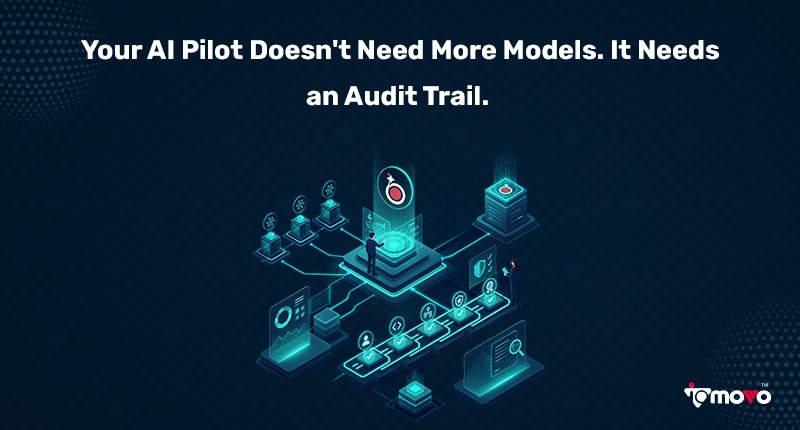
A complete, timestamped record of every action an AI agent takes, covering what it accessed, what it decided, why, and what changed as a result, held in a form somebody can reconstruct and verify later.
.svg)
Resources /
RegresarEvery enterprise AI roadmap this year reads about the same. Swap in a newer model, benchmark it against the old one, ship it, and do it again next quarter. Claude gets an upgrade. A better vision model drops. Somebody on the team saw an open source release on Friday and wants to try it Monday. The model conversation never really ends, and it was never really the problem.
I've sat in enough of these meetings to notice who never brings up models. Ask a compliance officer, a general counsel, or a CISO what actually worries them about agentic AI and you'll rarely hear a model name. You'll hear a question that is much simpler and much harder to answer: can you show me what the AI did, when it did it, what it touched, and why it made that call?
If the honest answer is "not really," no model upgrade is going to fix that. An AI audit trail will.
Key takeaways:
- A real audit trail captures five things about every agent action: who acted, what it accessed, why it decided, what it changed, and when.
- A newer model changes what your agent decides. It does nothing about whether you can prove what it decided.
- Deloitte found only 21 percent of enterprises have mature governance for autonomous agents, while 74 percent expect to be running them within two years.
- The EU AI Act's logging rules for high risk systems took effect on August 2, 2026. Audit readiness stopped being a best practice and became a legal obligation.
- ioMoVo builds logging, approval checkpoints, and permissions into the platform, so the audit trail holds no matter which model is running underneath.
Why the Model Race is a Distraction from the Real Risk
Model performance is easy to market. There are leaderboards, benchmark scores, a demo that looks sharper than the one you gave last quarter. Governance has none of that going for it. It lives in logs and permission tables, it photographs badly, and nobody asks to see it in a first meeting.
It is also the thing that decides whether your agent survives a conversation with a regulator, an auditor, or somebody's legal team. An audit trail is really just a record of every step an agent took, from the input it received to the action it finally performed. Without one, the number of models sitting behind your assistant is beside the point. There is nothing to point at when someone asks why.
Deloitte put a number on this in its State of AI in the Enterprise 2026, a survey of 3,235 technology and business leaders across 24 countries. Only 21 percent of organizations have a mature governance model for autonomous agents. Meanwhile 74 percent expect to be using them at least moderately inside two years. The part I would underline is Deloitte's own description of what the other four in five are missing: clear boundaries on which decisions an agent can make alone, monitoring that flags odd behavior while it is happening, and audit trails covering the full chain of agent actions.
None of that stays abstract for long. It turns into real exposure the first time an agent touches something regulated. An approval. A distribution decision. A piece of content that goes out with your brand on it.
What an Audit Trail Actually Means for an AI Agent
The phrase gets thrown around loosely, so let me be specific. An audit trail for an AI system, as opposed to an ordinary activity log, answers five questions about every single action an agent takes.
- Who or what acted. Which agent, which user, which service account set the action in motion.
- What it accessed. Every file, database, API, and asset it touched on the way there.
- What it decided, and why. The reasoning path or prompt chain behind the output, not only the output.
- What it changed. The action itself. A file moved. A workflow approved. An asset published outside the company.
- When it happened. A precise, tamper resistant timestamp, good enough that somebody who was not in the room can rebuild the sequence later.
Drop any one of those and what you have is a log. Useful for debugging on a Tuesday afternoon. Not much help in front of an auditor. A genuine trail shows what the agent did, when, why, and under which model configuration, following each span of activity from retrieval to tool call to inference to whatever human sign off happened along the way.
Why Adding More Models Doesn't Solve It
There is a comfortable logic to model chasing. The current model makes mistakes, so surely the next one will make fewer. But a new model changes what your agent decides. It does nothing about whether you can prove what it decided. A more capable model without a governance layer is still a black box. Just a faster and more confident one.
This is where agentic AI stops behaving like the automation we all grew up with. A script does exactly what somebody built it to do, every time, forever. An agent reads a goal and picks its own route there. So the question stops being whether the code ran correctly and becomes whether this particular decision, made by this particular agent, was authorized, explainable, and traceable. NIST built its AI Risk Management Framework around exactly that shift, aiming at trustworthiness across the whole lifecycle rather than output quality at the moment you deploy.
Governance is not a feature you attach to a model. It is the room the model has to work in.
Five Things to Check Before You Check the Model
If you are evaluating agentic AI for content operations, financial workflows, or patient records, these are worth working through before anyone asks which foundation model is under the hood.
- Defined permissions. What each agent is allowed to reach, decide, and execute, and what sits firmly outside its lane.
- Full decision logging. Every retrieval, tool call, and inference step, not just the final answer.
- Human checkpoints. Approval gates wherever an autonomous decision carries real business or regulatory weight.
- Model agnostic architecture. The freedom to swap, mix, or self host models without rebuilding governance around them each time.
- Retention that matches the regulation. Logs kept as long as the applicable framework requires, in a form an outside auditor can actually work with.
How ioMoVo Builds the Audit Trail In, Not On
We made this bet early at ioMoVo. Govern the platform, then let customers pick their own models. The digital asset management platform runs on a governed agentic architecture, six modules that work together (ioCloud, ioHub, ioAI, ioFlow, ioPilot, and ioPortal) where every AI action is scoped, logged, and reviewable because that is how it was designed, not because we added it later.
In practice that looks like this.
- Every action in the platform is recorded against an identifiable actor, human or agent, with a timestamp and a place in the library. ioPilot, our conversational assistant, gets no exemption from that. Its queries, retrievals, and actions land in the same record a person’s would.
- ioFlow runs the approval chains for brand, legal, and compliance review, so nothing moves from draft to distribution without a human checkpoint wherever your policy calls for one.
- ioAI is model agnostic by design. Commercial providers connect through one governed layer, today Claude, ChatGPT, Gemini, and Grok, alongside vision and multimodal models like CLIP, BLIP, Segment Anything, and YOLO. You can bring your own LLM keys, and connections for self hosted and Hugging Face models are on the roadmap. Changing models never means rebuilding your compliance posture from scratch.
- Sovereign and on premise deployment keeps processing, logs, and audit records inside your own infrastructure, including fully air gapped environments running at full feature parity. If you are in financial services, healthcare, life sciences, or the public sector, you already know data residency is not a preference.
The point is not that ioMoVo has a view on which model is best this quarter. It is that we do not need one, because the governance layer is what produces the answer an auditor is asking for. The model is a detail underneath it.
Are Regulators Actually Requiring This?
This is not a hypothetical I am dressing up for a blog post. It is law, and it has been for about a week. Article 12 of the EU AI Act requires high risk AI systems to record events automatically across the lifetime of the system. Article 19 requires providers to keep those logs for at least six months. Both took effect on August 2, 2026, and the penalties reach 15 million euros or 3 percent of global annual turnover. Writing things down by hand does not count. The system has to generate the record itself.
There is no equivalent mandate in the United States yet. What there is, in the NIST AI Risk Management Framework, is a structure that examiners, boards, and customers already recognize. Adopting it now is a considerably better position than assembling one later under pressure.
Because the teams treating logging as a problem for next quarter are the ones who will end up reconstructing a decision trail after the fact. Usually on the worst possible day, with a regulator or an attorney already on the line.
Frequently Asked Questions
Before you add another model to the stack, ask what happens when someone asks your AI agent to explain itself.
See how our governed agentic architecture puts an audit trail behind every action. Book a demo or take a look at the full platform.
¡Complete el siguiente formulario para comenzar!
Transform How Your Organization Manages Content
Unlock hidden value in your content with AI — faster discovery, better workflows, and organized collaboration
Ready to see how ioMoVo can fit your team?