.svg)
The Pipeline Theory: How AI Became the Fourth Infrastructure

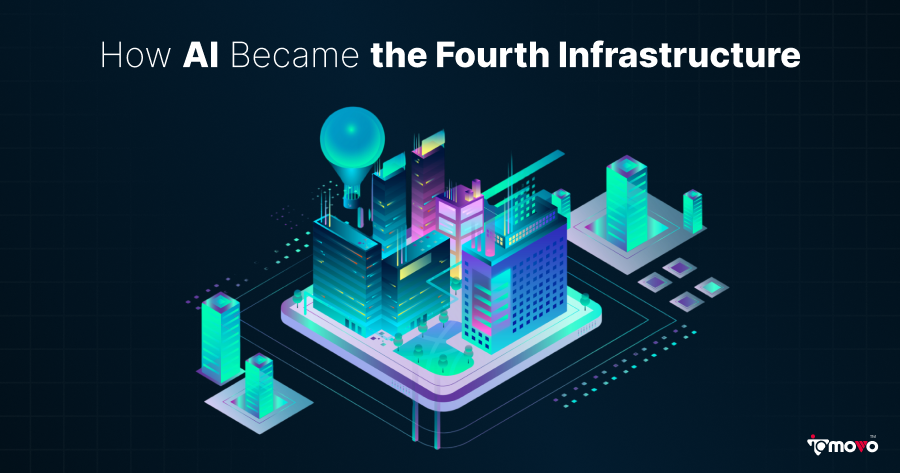
Every era gets defined by its infrastructure. Energy powered the Industrial Revolution. Telecom connected the world. The internet digitized commerce. AI is next.
AI is becoming the fourth infrastructure layer, with power residing in controlling the complete pipeline: data → storage → compute → intelligence. Nations and enterprises that control this pipeline will define the next economic era.
To understand why, we need to examine the pattern.
The Pattern of Infrastructure Power
Infrastructure waves follow a predictable pattern. Each transforms economies and creates new power structures. In the 1880s through 1920s, electricity transformed entire industries. Companies like General Electric and Westinghouse defined the era.
Telecom came next. Telegraph to telephone to mobile networks connected global commerce from the 1920s through the 1990s. AT&T and telecommunications monopolies held unprecedented power.
Then came the internet. Fiber optic cables, data centers, and cloud computing digitized the economy. AWS, Google, and Microsoft became infrastructure owners.
Infrastructure always starts as novel technology, becomes a critical utility, and then creates a concentration of power. Those who own the pipes control the flow.
Organizations must think about a unified data infrastructure the same way nations thought about energy independence.
What is an AI Pipeline?
An AI pipeline is a four-stage system where value flows from raw data to actionable intelligence.
Stage 1: Data Ingestion and Collection
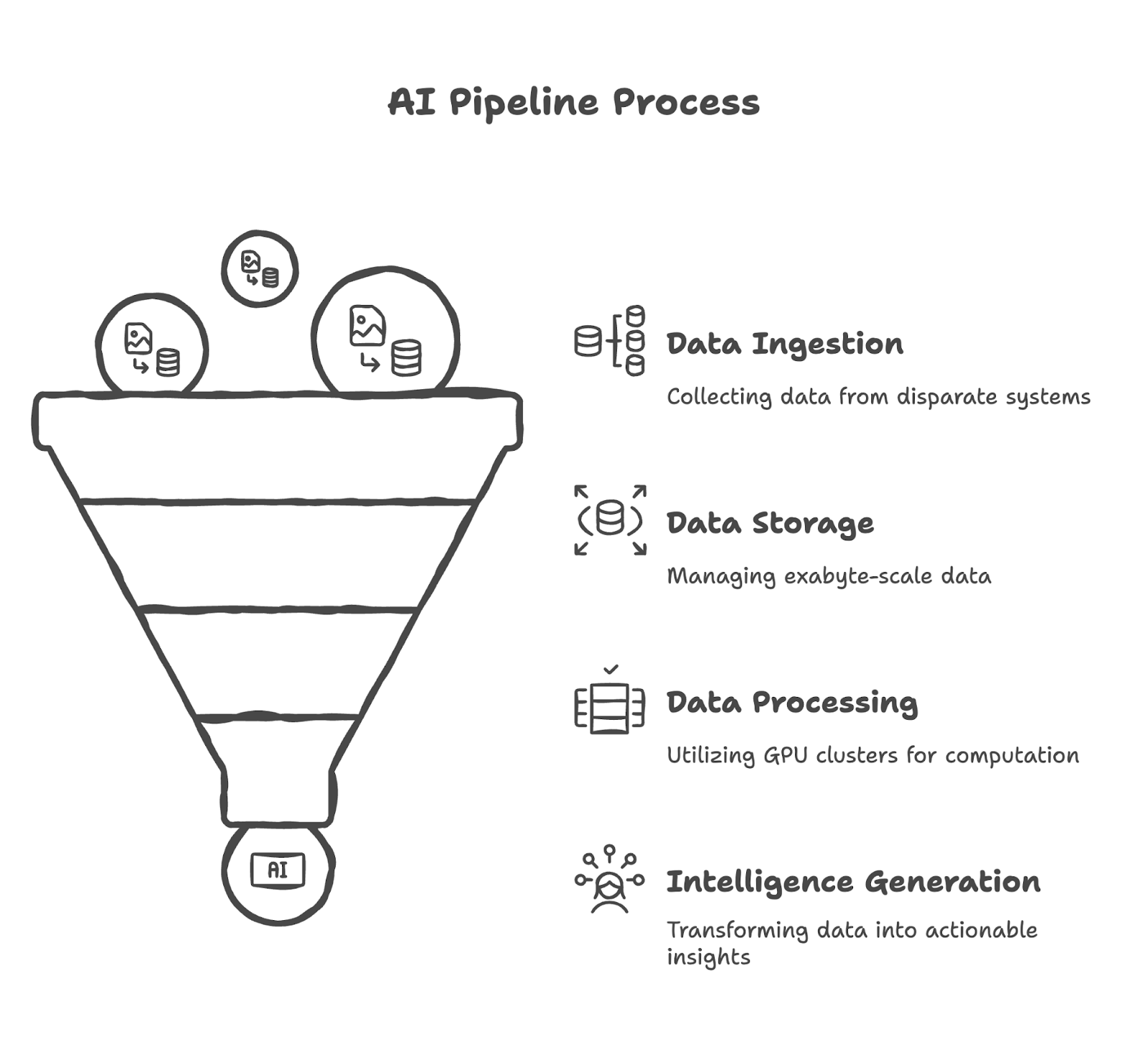
The first stage pulls multimodal data from multiple sources. The challenge is fragmentation. Data silos across incompatible systems create severe limitations. Enterprises average 10 or more disconnected storage systems.
Platforms that unify disparate storage solve this by connecting systems like Google Drive, SharePoint, Dropbox, AWS, and Azure without forced migration.
Stage 2: Storage and Management Layer
AI workloads need exabyte-scale data with AI-optimized access patterns. AI workloads need unprecedented data volumes to learn and evolve. The problem: 75% of enterprise data remains at or near the source by 2025.
AI-ready cloud storage must handle distributed data while maintaining performance.
Stage 3: Compute and Processing Layer
GPU clusters and accelerated computing make up the third stage. Meta deployed 350,000 H100 chips by the end of 2024. Companies are building gigawatt AI factories.
Stage 4: Intelligence Generation Layer
The final stage transforms raw data into actionable intelligence. Jensen Huang calls the outputs "tokens" as units of intelligence. Raw data comes in, intelligence goes out.
Automated content intelligence platforms handle auto-tagging, transcription, and object detection. Conversational AI assistants make that intelligence accessible through natural language.
Why This Matters
Traditional ETL pipelines move and copy data. AI pipelines minimize movement through in-place transformation and real-time processing.
Every stage adds value and creates dependency. Organizations that own their entire pipeline retain strategic control.
Sovereign AI: Why Nations Are Racing to Build Pipelines
Sovereign AI is a nation's capability to produce AI using its own infrastructure, data, and workforce. The goal is to protect local languages, values, and culture. Data sovereignty equals national sovereignty.
The Economic Security Imperative
AI factories are becoming the bedrock of modern economies, according to Jensen Huang. Access to AI supercomputing is now a critical national infrastructure.
The global GPUaaS market for telcos will reach $35-70 billion by 2030, per McKinsey. The compute divide is the new digital divide.
Real-World National Investments
Countries are building sovereign AI now.
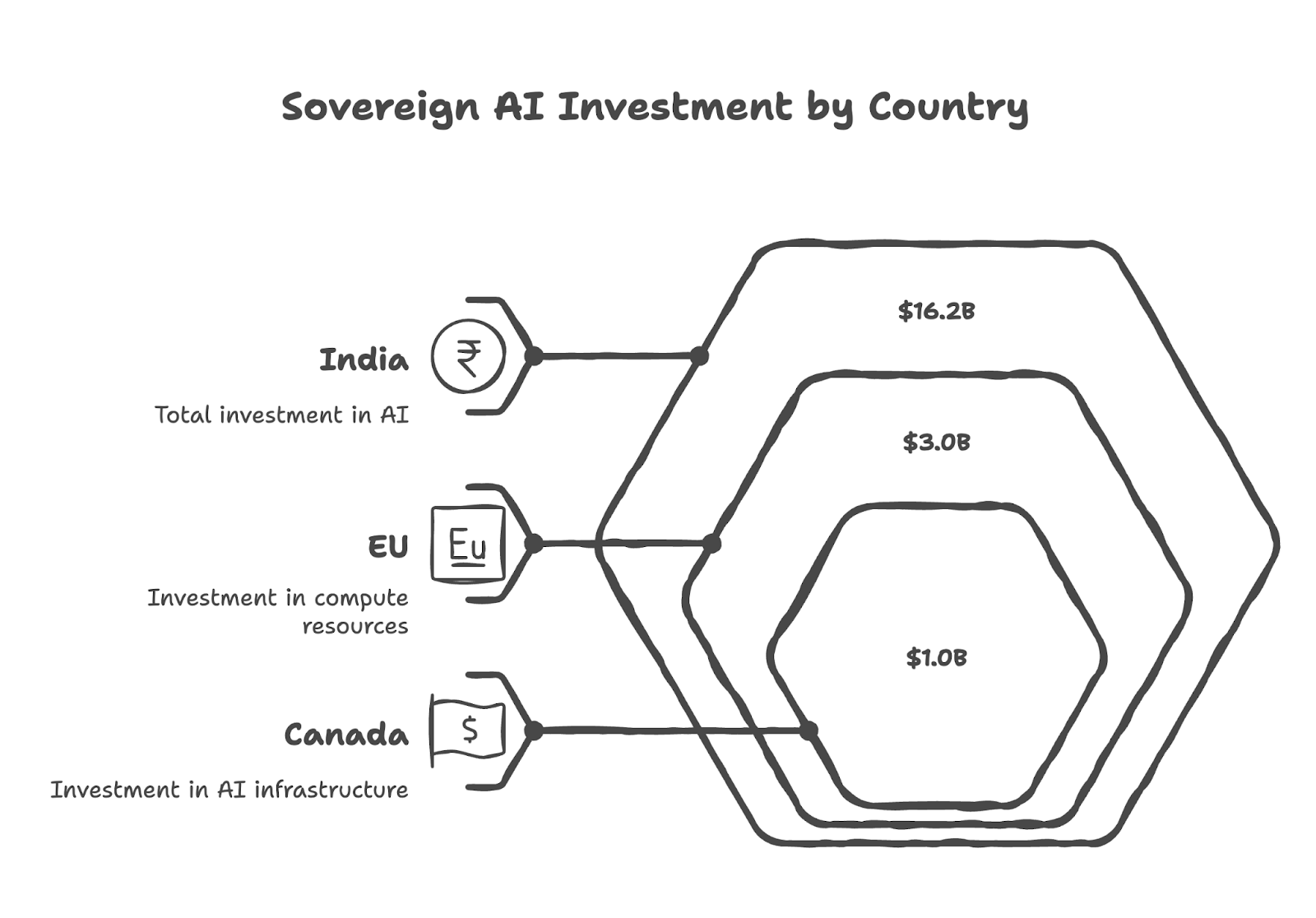
- Canada invested $1+ billion in its AI Sovereign Compute Infrastructure to secure AI leadership through cutting-edge computing.
- The European Union is deploying 3,000+ exaflops of compute resources across France, Germany, Italy, Spain, and the UK to strengthen digital sovereignty.
- India launched IndiaAI Mission with $1.2 billion over five years, targeting 3,000 AI petaflops. Google committed $15 billion to an AI hub in Visakhapatnam.
- Singapore upgraded its National Supercomputer Center with H100 GPUs. Singtel is building energy-efficient AI factories across Southeast Asia.
- The Middle East is building major infrastructure. The UAE Stargate project uses NVIDIA GB300 systems.
Six Strategic Pillars of Sovereign AI
The World Economic Forum identifies six pillars nations must address:
- Digital infrastructure, like data centers and computing
- Workforce development through STEM education and AI skills training
- Data governance, including localization and sovereignty
- Foundation models through domestic LLMs
- Regulatory frameworks covering AI safety and ethics
- Industry applications with sector-specific deployment
Enterprise Sovereignty Matters Too
The same principles apply at the company level. Organizations need control over their data-to-intelligence pipeline. Pipeline control equals competitive advantage. Government organizations and enterprises need systems that maintain data sovereignty while enabling AI capabilities.
ioMoVo's Position in the Intelligence Pipeline
ioMoVo sits between storage and intelligence layers and enables organizations to maintain pipeline control while building AI capabilities.
Data Layer Control
ioHub unifies storage systems, including Google Drive, SharePoint, Dropbox, AWS, and Azure. The Bring Your Own Storage model means no vendor lock-in. Organizations retain infrastructure control while gaining intelligence capabilities.
Intelligence Generation
ioAI delivers automated intelligence through auto-tagging, transcription, facial recognition, and object detection across video, images, audio, and documents.
It also provides conversational AI with natural language search across your entire library. This democratizes intelligence access without technical expertise.
Workflow Orchestration
ioFlow automates workflow management with task routing, approval processes, and status tracking. Intelligence flows through your organization efficiently.
Why This Matters
Organizations build AI capabilities without surrendering data. They maintain compliance with sovereignty requirements and avoid vendor lock-in. Media organizations process petabytes without losing control. Government agencies meet residency requirements while using AI.
Traditional DAM systems are storage-first. Cloud AI providers require data surrender. ioMoVo enables both without compromise.
The Future: Edge, Factories, and Distributed Intelligence
The AI pipeline is evolving. Three major trends are reshaping how organizations think about intelligence infrastructure.
Edge Computing Revolution
Edge computing will grow from $168.4 billion to $249 billion by 2030. Edge AI will expand from $20.78 billion to $66.47 billion in the same period.
Edge computing reduces latency for real-time inference, keeps sensitive data at the source, and lowers bandwidth costs. By 2025, 75% of enterprise data will remain at or near the source.
Edge AI enables critical applications across industries:
- Manufacturing needs real-time quality control and predictive maintenance
- Healthcare requires medical imaging analysis at the point of care
- Autonomous systems must process vehicle AI locally
- Retail uses in-store customer analytics
- Smart cities need traffic management and public safety systems
All of these applications require edge AI.
AI Factories Proliferate
Jensen Huang describes AI factories as data centers that produce intelligence when you apply energy. The outputs are tokens.
Every major company will have two factories: one for products, another for AI. Telecom operators like Singtel, Telefonica, and Telstra are building across five continents.
Distributed Intelligence Architecture
A three-tier model is emerging: central data centers for training, regional edge for inference, and device edge for real-time decisions.
Organizations need unified views across distributed infrastructure. Managing distributed systems requires platforms that work across the entire architecture. Every device becomes an AI endpoint.
Building Your Intelligence Pipeline
Every infrastructure wave created new power structures. AI infrastructure is no different.
Nations are investing $100+ billion in sovereign AI infrastructure. Enterprises must think the same way. The pipeline theory is not abstract. It determines who controls the future.
Ask yourself:
Do we control our data layer?
Can we generate intelligence without exposing it to third parties?
Is our infrastructure ready for distributed AI?
ioMoVo provides platform infrastructure designed for pipeline sovereignty. It works with your existing systems without requiring replacement. It enables intelligence generation while maintaining control.
AI infrastructure is being built today. Decisions made now determine competitive position for decades. Just as electricity, telecom, and internet infrastructure defined their eras, the AI pipeline will define ours.
The question is not whether to build it. The question is who will control it.
املأ النموذج أدناه للبدء!
Transform How Your Organization Manages Content
Unlock hidden value in your content with AI — faster discovery, better workflows, and organized collaboration
Ready to see how ioMoVo can fit your team?
-The-Future-of-DAM.jpg)

.jpg)