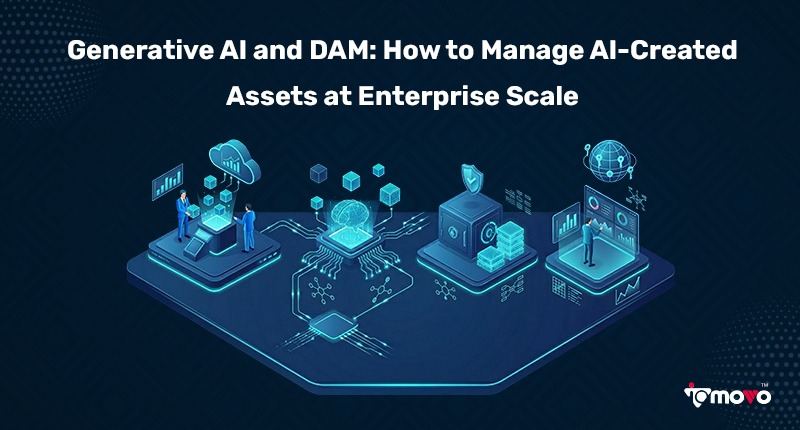
A traditional DAM is optimized for human-created asset ingestion, manual tagging, and folder-based organization. An AI-ready DAM supports automated metadata enrichment, prompt-to-asset pipelines, AI provenance tracking, and governance workflows designed for high-volume AI content production.
.svg)
Resources /
BlogGenerative AI and DAM: How to Manage AI-Created Assets at Enterprise Scale

Author
Jay HajeerIntroduction: The Enterprise Asset Crisis Nobody Predicted
Enterprises didn't expect to drown in content — but here we are.
In 2023, it took a team of designers two weeks to produce a campaign's visual assets. In 2025, the same output takes an afternoon with generative AI tools. The bottleneck didn't disappear — it moved. It is now at governance, organization, and discoverability. Your Digital Asset Management (DAM) system was built for a world where humans created assets slowly. Generative AI broke that assumption entirely.
This article is a definitive guide for enterprise marketing, IT, and content operations teams navigating the intersection of generative AI and DAM — covering workflows, metadata strategies, governance frameworks, compliance risks, and how platforms like iomovo.io are positioning DAM for an AI-first future.
What is Generative AI Asset Management? (And Why Enterprises Need It Now)
Generative AI asset management refers to the systems, workflows, and policies that govern how AI-created content — images, videos, copy, audio, 3D models, synthetic data — is stored, tagged, reviewed, approved, distributed, and retired within an organization.
It sits at the crossroads of:
- Digital Asset Management (DAM) — the platform layer
- AI content operations — the workflow layer
- Content governance and brand compliance — the policy layer
The Scale Problem in Numbers
- Enterprises using generative AI tools report producing several times more than pre-AI baselines
- Teams waste an average of 9.3 hours per week searching for information and internal content — a burden that compounds significantly as AI-generated assets flood DAM systems without proper metadata or governance structures (McKinsey & Company, The Social Economy, 2012)
Without a structured DAM strategy built for generative AI, organizations face duplicated assets, brand inconsistency, compliance exposure, and compounding technical debt.
The 5 Biggest Challenges of Managing AI-Created Assets at Enterprise Scale
1. Metadata Poverty
Human-created assets arrive with context: the designer knows the project, the brief, the intended use. AI-generated assets are born from a prompt - — and that prompt is usually lost the moment the file is saved.
What's missing: source prompt, model used, generation date, intended campaign, approved variants, license status, brand guideline version.
What metadata should AI-generated images have in a DAM?
At minimum: generation prompt, AI model and version, date created, usage rights status, campaign association, approval status, and brand compliance flag.
2. Version and Variant Explosion
A single product photo request to Midjourney or Adobe Firefly can produce 20–50 variants in minutes. Multiply that across teams, regions, and campaigns, and your DAM storage balloons with near-duplicate assets that have no clear hierarchy.
Best practice: Implement parent-child asset relationships in your DAM — one canonical "approved" asset linked to all its AI variants, with clear deprecation policies.
3. Rights and Compliance Ambiguity
AI-generated content exists in a legal grey zone. The U.S. Copyright Office has confirmed it will not register works created entirely by AI without human authorship. In the EU, AI Act provisions intersect with GDPR and IP law in ways most legal teams are still mapping.
Enterprise risk: Using AI assets that incorporate training data from copyrighted works without disclosure creates downstream liability, especially in regulated industries (financial services, pharma, healthcare).
What to do: Tag all AI-generated assets with a provenance record — which model generated it, what input data was used, and whether a human creative reviewed and modified it.
4. Brand Drift at Scale
Generative AI tools produce "good enough" output extremely quickly. The problem: "good enough" deviates from brand guidelines over time. Colors shift slightly. Typography references become inconsistent. Tone in AI copy homogenizes.
When assets are produced at scale without a centralized governance layer, brand identity erodes one asset at a time. Research from Marq (formerly Lucidpress) shows that consistent branding can increase revenue by up to 33% — meaning the inverse cost of inconsistency is substantial. (Marq, State of Brand Consistency Report, 2019)
Solution framework: Build AI brand guardrails into your DAM intake workflow — automated checks against brand guidelines before an AI asset is promoted from draft to approved status.
5. Searchability and Discoverability Gaps
AI-generated assets often lack the contextual signals that make DAM search useful. Traditional DAM search relies on file names, manually entered tags, and folder structures — none of which scale with AI production velocity.
The fix: Leverage AI-powered metadata enrichment (auto-tagging, semantic search, CLIP-based visual search) within your DAM to retroactively enrich AI-generated content and surface it accurately.
A Framework for Enterprise-Scale AI Asset Management
Phase 1: Intake and Capture
Every AI-generated asset entering your ecosystem needs a standardized intake workflow:
Required at intake:
- Prompt or generation brief
- Tool/model used (e.g., DALL·E 3, Stable Diffusion XL, Adobe Firefly, Sora)
- Requestor and team
- Intended use case and campaign
- Initial rights/compliance status
Recommended: Integrate your AI generation tools directly with your DAM via API or native connector. Platforms like iomovo.io enable direct pipeline connections, so assets move from generation into the DAM instantly — with metadata fields populated at creation, not after the fact.
Phase 2: Automated Enrichment
Human tagging cannot keep up with AI generation velocity. Automated enrichment is not optional — it is infrastructure.
Enrichment stack:
- Visual AI tagging — object detection, scene classification, color extraction
- Semantic metadata — NLP-based concept tagging from prompts and file names
- Brand compliance scoring — automated checks against color palettes, logo placement zones, typography rules
- Similarity detection — flag near-duplicate AI variants before they multiply
Phase 3: Governance and Approval Workflows
AI assets should not go directly to distribution. A lightweight governance layer protects brand consistency and legal compliance without creating bottlenecks.
Recommended workflow:
Generate → Auto-enrich → Brand check → Human review → Approve/Reject → Publish → Archive
Configurable approval tiers based on asset type and risk:
- Tier 1 (Low risk): Internal-use AI copy → single reviewer
- Tier 2 (Medium risk): Customer-facing visuals → brand team review
- Tier 3 (High risk): Legal, regulated content, executive communications → legal + compliance sign-off
Phase 4: Distribution and Rights Management
Once approved, AI assets need clear usage parameters in the DAM record:
- Approved channels (web, social, print, OOH)
- Geographic restrictions
- Expiry date and review schedule
- Derivative use permissions
AI platforms and search engines are increasingly indexing structured content. Marking up AI-generated assets with Schema.org, Image Object, Media Object, and Creative Work properties — including creator set to a software agent — signals provenance to both humans and machines.
Phase 5: Lifecycle Management and Retirement
The most neglected phase. AI assets expire — campaigns end, products change, regulations shift.
Automated lifecycle triggers:
- Campaign end date → auto-archive
- Brand guideline version update → flag for re-review
- Rights expiry → auto-quarantine
- Low engagement signal (from analytics integration) → surface for review
Generative AI DAM: Technology Stack Considerations
When evaluating or upgrading your DAM for generative AI workflows, assess across five capability dimensions:
Platforms purpose-built for modern content operations — like iomovo.io — are building these capabilities natively rather than patching them onto legacy DAM architecture. The difference matters at enterprise scale: a 100,000-asset library managed in a legacy DAM becomes a liability; the same library in an AI-native DAM becomes a competitive advantage.
Frequently Asked Questions
Conclusion: The DAM is Now the AI Command Center
Generative AI did not make Digital Asset Management obsolete. It made it essential.
The enterprises that will win content in the next three years are not the ones generating the most AI assets — they are the ones governing, organizing, and distributing those assets most effectively. The DAM is no longer a passive archive. It is the operational command center for AI-powered content at scale.
The framework is clear: build intake workflows that capture provenance at the moment of creation, automate enrichment to compensate for volume, enforce governance without creating bottlenecks, manage rights proactively, and retire assets systematically.
Platforms built for this reality — natively integrating generative AI tools with structured governance and intelligent metadata — are defining the next generation of content operations.
The question for every enterprise content leader is not whether to build this infrastructure. It is whether you build it before or after your competitors do.
Ready to Bring Your AI Asset Chaos Under Control?
iomovo.io is the AI-native Digital Asset Management platform built for enterprise content teams managing generative AI at scale. Automated metadata enrichment, built-in brand compliance, prompt-to-DAM pipelines, and governance workflows — all in one place.
Start Your Free Enterprise Trial
No credit card required.
Fill Out the Form Below to Get Started!
Transform How Your Organization Manages Content
Unlock hidden value in your content with AI — faster discovery, better workflows, and organized collaboration
Ready to see how ioMoVo can fit your team?
-The-Future-of-DAM.jpg)


.jpg)