.svg)

Every infrastructure wave created new dependencies. Now, as nations race to build sovereign AI, they face a critical flaw: you can't build AI sovereignty on someone else's cloud.
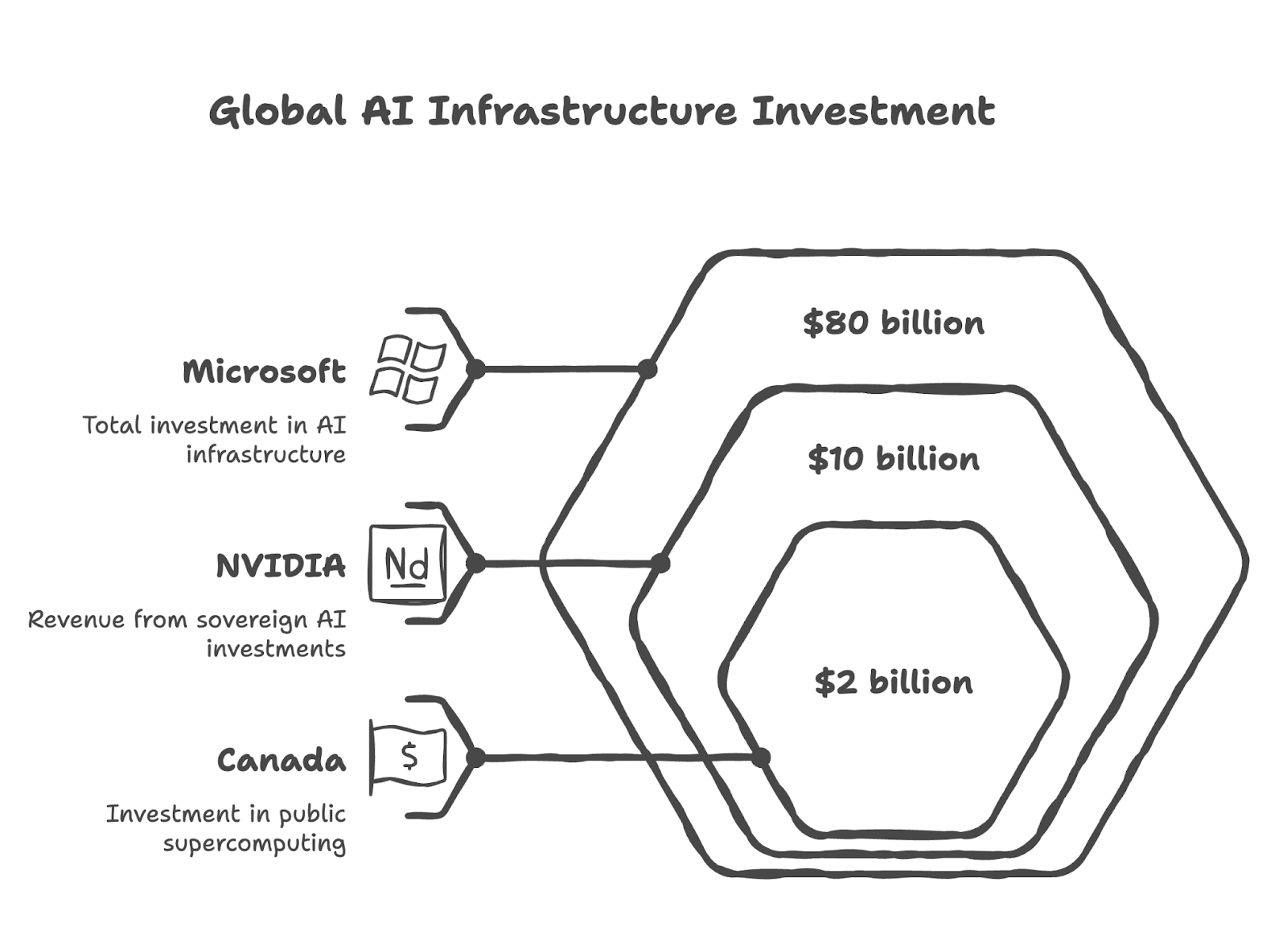
Microsoft, Amazon, Google, and Meta spent more than $100 billion in the first six months of 2024 on AI and cloud infrastructure. Yet most sovereign AI initiatives still run on hyperscaler infrastructure.
Q3 2025 marked the quarter when compute became sovereignty itself, according to Global Data Center Hub. Data sovereignty does not equal AI sovereignty. Cloud infrastructure is transforming, but not everyone controls the transformation.
The Global Compute Race and Its Hidden Trap
Nations worldwide are pouring billions into AI infrastructure. But many are building on foundations they don't control.
Canada's sovereign AI compute strategy includes $2 billion over five years. NVIDIA projected $10 billion in revenue from government sovereign AI investments in 2024, according to Bain & Company.
But nations build domestic large language models yet run them on foreign clouds. They achieve training sovereignty without operational sovereignty.
The CLOUD Act gives US authorities access to data stored by American companies anywhere in the world. Countries can't afford to rely on others for AI capabilities due to the economic value at stake, Bain researchers found.
The Risks of Hyperscaler Dependency
Hyperscaler dependency creates five critical risks:
- Jurisdictional vulnerability: The US CLOUD Act reaches data stored by American companies anywhere globally. VMware researchers note that hyperscalers cannot offer true sovereignty to European customers because they cannot exempt themselves from extra-territorial laws. And what is the real risk here? A kill switch scenario where providers cut access.
- Vendor lock-in: Proprietary services create technical dependencies. Sixty-seven percent of German companies say they cannot operate without US hyperscalers, according to research cited by the World Economic Forum.
- Economic dependency: Microsoft reported a 17% year-over-year revenue increase. AWS's quarterly operating income jumped from $14.7 billion in Q2 2024 to $19.2 billion in Q2 2025. These aren't the earnings of a fiercely competitive market, Computer Weekly observed.
- Operational control loss: Organizations undergo profound institutional changes when migrating to hyperscaler clouds. These changes can compromise their ability to fulfill public interest missions.
- Sovereign washing: Many providers market data residency as sovereignty. Real sovereignty requires both legal and operational control.
Sixty-one percent of Western European CIOs say geopolitical risks will restrict their use of hyperscalers.
The defining question isn't "Where is my data?" but "Who has ultimate control over my data?"
What Makes a Cloud Sovereign
True cloud sovereignty is not the same as the feature you buy because it's essentially a state you architect.
Gartner identified three core principles that define genuine sovereignty:
- Data sovereignty: Data remains subject to the laws of the country where it's collected. All data and metadata stay under local jurisdiction. No external access exists, even by the cloud provider.
- Operational sovereignty: Local staff with required citizenship or clearances manage the infrastructure. Management and control planes operate independently.
- Technological sovereignty: Organizations maintain the ability to operate infrastructure independently. Organizations need the option to create air-gapped environments.
Oracle outlines six capabilities defining sovereign clouds, including dedicated and secure networking.
Foundation models get trained on domestic data. Sovereign AI encompasses both physical and data infrastructures, NVIDIA explains.
ioCloud provides AI-ready infrastructure with sovereignty controls. Saudi Arabia's PDPL mandates that personal data must be processed within Saudi borders.
The Sovereign AI Stack: Storage to LLMs
Sovereign AI is a complete stack where every layer operates under local control.
Layer one covers sovereign storage and data management. Saudi Arabia's PDPL became fully enforceable on September 14, 2024.
ioHub unifies data across sovereign and non-sovereign storage.
Layer two builds sovereign compute infrastructure. This requires local data centers, GPUs, and supercomputing capacity. Organizations can choose from multiple deployment models based on their sovereignty requirements:
Oracle invested in Saudi Arabia with two public regions. Oracle Cloud Isolated Region serves Singapore's defense sector. Microsoft built 100,000 NVIDIA GPUs in Norway. Layer three ensures governance and operational control. Local staff need the required citizenship. Control planes operate independently.
Layer four creates sovereign foundation models. National LLMs preserve languages and cultural values.
Countries worldwide are building their own foundation models:
- Netherlands: GPT-NL built specifically for Dutch language and culture
- Portugal: Amalia developed for government use and Portuguese linguistic needs
- Switzerland: Apertus supporting multilingual requirements, including Swiss German and Romansh
- India: Reliance developing a foundation LLM for diverse Indian languages
- Italy: Fastweb partnering with NVIDIA on the first Italian-native LLM
- Taiwan: Academia Sinica built a Taiwanese LLM, though initial versions revealed data bias issues
Taiwan provides a cautionary tale. When their LLM was asked "What is National Day?" it answered "October 1"—China's national day, not Taiwan's October 10. The model learned from data influenced by Chinese perspectives.
European countries are investing heavily because they understand this reality.
ioAI generates intelligence from content without exposing data to third parties. Auto-tagging, transcription, and multi-modal AI all happen within sovereign boundaries.
Building Sovereign Capabilities with ioMoVo
ioMoVo's architecture deploys across public cloud regions, dedicated regions, and air-gapped environments. The platform works with Oracle Cloud Infrastructure sovereign regions.
The sovereign data layer uses a Bring Your Own Storage model. ioFlow automates workflows within compliance boundaries.
The platform supports SOC 2, GDPR, and HIPAA. It's designed for government, financial services, healthcare, defense, and media organizations.
The Future: Every Country with Its Own LLM
The endgame is complete AI ecosystems within national borders. Europe leads with the Netherlands, Portugal, Switzerland, France, Germany, and Italy building national models. Asia-Pacific follows with India, Japan, Singapore, Taiwan, and South Korea.
Language preservation and value alignment drive adoption.
India committed $1.24 billion for a sovereign AI platform with 10,000+ GPUs. Japan pledged $740 million for AI supercomputers. The EU allocates €1 billion annually through 2027.
Air-gapped AI deployments are rising in defense and intelligence sectors. Singapore's Defence Science and Technology Agency selected Oracle Cloud Isolated Region for the Ministry of Defence.
Edge computing markets are exploding. The edge computing market grows from $168.4 billion in 2025 to $249 billion by 2030. Edge AI expands from $20.78 billion in 2024 to $66.47 billion by 2030.
Edge matters for sovereignty because data sovereignty starts at the point of collection. Seventy-five percent of enterprise-generated data will remain at or near the source by 2025.
NVIDIA CEO Jensen Huang predicts every country will have its own AI. France positions Mistral as Europe's digital independence card. The Atlantic Council warns that unless a nation owns sovereign AI, it will be controlled by others who already do.
Building Your Sovereign AI Pipeline
Sovereignty is about who controls the entire AI pipeline from storage to compute to intelligence generation. More than $100 billion has been invested in sovereign AI globally. Countries that don't own their AI pipelines will depend on those that do.
Organizations need to assess four critical layers:
- The data layer: Do you control your data storage or face lock-in to proprietary systems? Can you maintain sovereignty across distributed infrastructure?
- The compute layer: Can you deploy in sovereign regions or air-gapped environments when needed? Do you have options beyond hyperscaler public clouds?
- The intelligence layer: Can you generate AI insights without exposing data to third parties? Do you own the models and training processes?
- The governance layer: Do you have operational control or just data residency? Can you operate independently if vendor relationships end?
ioMoVo's platform designs for sovereignty at every layer. Deployment spans public clouds, sovereign regions, and air-gapped environments. Compliance covers SOC 2, GDPR, HIPAA, and PDPL requirements.
AI infrastructure being built today will define competitive position for decades.
The question is who will control it.
املأ النموذج أدناه للبدء!
Transform How Your Organization Manages Content
Unlock hidden value in your content with AI — faster discovery, better workflows, and organized collaboration
Ready to see how ioMoVo can fit your team?
-The-Future-of-DAM.jpg)

.jpg)